
- Details
- Written by: Matej Tilovski
- Category: Drivers
- Hits: 0
A Formula One constructor is the entity credited with designing the chassis and the engine.[141] If both are designed by the same company, that company receives sole credit as the constructor (e.g., Ferrari). If they are designed by different companies, both are credited, with the name of the chassis designer being placed before that of the engine designer (e.g., McLaren-Mercedes). All constructors are scored individually, even if they share a chassis or engine with another constructor.[142] Entering a new team in the Formula One World Championship requires a $450 million up-front payment to the FIA, which is then shared equally among the existing teams.[143]
Since 1981, Formula One teams have been required to build the chassis in which they compete.[144] This requirement distinguishes Formula One from series such as the IndyCar Series, that allow teams to purchase chassis, and "spec series", such as Formula 2, that require all cars be built to identical specifications.[145][146] Despite this rule, however, two teams used chassis built by other teams in 2007. Super Aguri started the season using a modified Honda Racing RA106 chassis, while Scuderia Toro Rosso used the same chassis used as its parent Red Bull Racing team, which was formally designed by a separate subsidiary. The exploitation of these loopholes was ended for 2010 with the publication of new technical regulations, which require each constructor to own the intellectual property rights to their chassis,[147]

Ten out of the eleven teams competing in Formula One have some form of base in England, in an area centred around Oxfordshire called "Motorsport Valley".[148][149][150] Ferrari is the only team to not have an English presence and have both their chassis and engine assembly in Maranello, Italy.[151] Racing Bulls is based close to Ferrari in Faenza but also has a base in Milton Keynes,[152] whilst Audi is based in Hinwil, Switzerland, with a "technology centre" in Bicester.[153] Haas is U.S.-based and has its primary base in Kannapolis, North Carolina, with another facility in Banbury and a design office in Maranello.[150][154][155] Cadillac has bases in Fishers, Indiana, Warren, Michigan, and Silverstone.[102]
- Details
- Written by: Matej Tilovski
- Category: Drivers
- Hits: 0
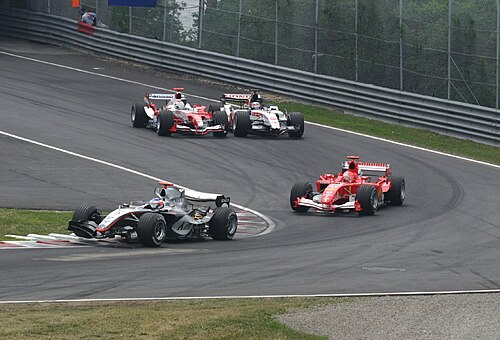 Every team in Formula One must run two cars in every session in a Grand Prix weekend, and every team may use up to four drivers in a season.[104] A team may also run two additional drivers during Free Practice sessions,[104] which are often used to test potential new drivers for a career as a Formula One driver or allow experienced drivers to evaluate the car.[156] Most drivers are typically contracted for at least the duration of a season,[157] with driver changes taking place in-between seasons.[158] Recent years, however, have seen a move away from this trend, with teams replacing drivers such as Daniel Ricciardo,[159] Logan Sargeant,[160] and Jack Doohan mid-season.[161]
Each competitor must be in the possession of an FIA Super Licence to compete in a Grand Prix,[162] a licence that is issued to drivers who have met the criteria of success in junior motorsport categories and have achieved 300 kilometres (190 mi) of running in a Formula One car in 2 days.[163][162] Teams can also contract reserve drivers to stand in for regular drivers when necessary and develop the team's car.[164] With the reduction in testing, however, the reserve drivers' role mainly takes place on a simulator,[165] such as rFpro,[166] which is used by most of the F1 teams.[167]
Each driver chooses an unassigned number from 2 to 99 (excluding 17, which was permanently retired following the death of Jules Bianchi)[168] upon entering Formula One and keeps that number during their time in the series. The number one is reserved for the reigning Drivers' Champion, who retains their previous number and may choose to use it instead of the number one.[169] At the onset of the championship, numbers were allocated by race organisers on an ad hoc basis from race to race.[170]
Permanent numbers were introduced for the 1974 season. Teams were allocated numbers in ascending order based on the Constructors' Championship standings at the end of the 1973 season. The teams would hold those numbers from season to season except for the team with the World Drivers' Champion, which would swap its numbers with the one and two of the previous champion's team.[171] New entrants were allocated spare numbers, except for the number 13, which has only ever been used by Divina Galica and Pastor Maldonado.[172]

As teams kept their numbers for long periods of time, car numbers became associated with a team, such as Ferrari's 27 and 28.[170] A different system was used from 1996 to 2013. During that time, at the start of each season the current Drivers' Champion was designated number one, their teammate number two, and the rest of the teams assigned ascending numbers according to the previous season's Constructors' Championship order.[171]
As of 2025, a total of 35 separate drivers have won the World Drivers' Championship, with Michael Schumacher and Lewis Hamilton holding the record for most championships, each with seven.[173] Jochen Rindt is the only posthumous World Champion, after his points total was not surpassed despite his fatal accident at the 1970 Italian Grand Prix, with 4 races remaining in the season.[174] Drivers from the United Kingdom have been the most successful in the sport, with 21 championships among 11 drivers and 331 wins as of 2026.[175]
Physical demands
Driving in Formula One is highly demanding physically, with drivers typically burning around 1,000 calories per hour and losing up to 5% of their body weight per race.[176][177] A key reason for the physical demands is the extreme g-force generated by driving at high speeds, with modern Formula One cars capable of generating forces of up to 6.5 gs when cornering (i.e. feeling a force equivalent to six and a half times their body weight), 6 gs when braking, and 2 gs when accelerating.[178][179][180] Another factor is the high temperature inside the car, as the engine is mounted directly behind the driver. The temperature in the cockpit of a Formula One car can be as high as 60 °C (140 °F), and drivers have to wear several layers of fireproof clothing.[181][182] The steering wheel and brake pedal also require considerable strength to operate. Before the introduction of power steering in the 2000s, drivers had to cope with steering forces of up to 40–50 newton-metres (30–37 lb⋅ft),[183][184] while achieving maximum braking power requires drivers to apply around 150 kg (330 lb) of force to the brake pedal.[185]
Any excess weight noticeably reduces a driver's performance, so they must be as light as possible – though a minimum limit of 82 kg (181 lb) has been enforced by the FIA "in the interests of well-being".[176][186] They also need to train for cardiovascular fitness since heart rates can, on average, exceed 170 bpm during a race.[187]
Feeder series


Most F1 drivers start in kart racing competitions and then progress through traditional entry-level European single-seater series such as Formula Ford,[188] Formula Renault,[189] and Formula 4.[190] From there, drivers typically progress to higher-level regional championships at the Formula Three level, which include championships such as British F3 and European F3 historically, although similar series now hold the Formula Regional designation. In addition to this, there are also international F3 championships, including GP3 and its present-day successor, FIA F3.[191] The highest level series on the F1 ladder is the FIA Formula 2 Championship. In the past, the top level series was GP2 (2005–2016), International Formula 3000 (1985–2004 under the Formula 3000 class), and Formula Two (1948–1984).[192][193]
Drivers are not required to have competed at all levels to enter Formula One. British F3 has supplied many F1 drivers, with champions, including Nigel Mansell,[194] Ayrton Senna,[195] and Mika Häkkinen[196] having moved straight from that series to Formula One. Max Verstappen made his F1 debut following a single season in European F3.[197] More rarely, a driver may be picked from an even lower level, as was the case with 2007 World Champion Kimi Räikkönen, who went straight from Formula Renault to F1.[198]
American open-wheel car racing has also contributed to the Formula One grid. CART champions Mario Andretti and Jacques Villeneuve became F1 World Champions, while Juan Pablo Montoya won seven races in F1.[199]